

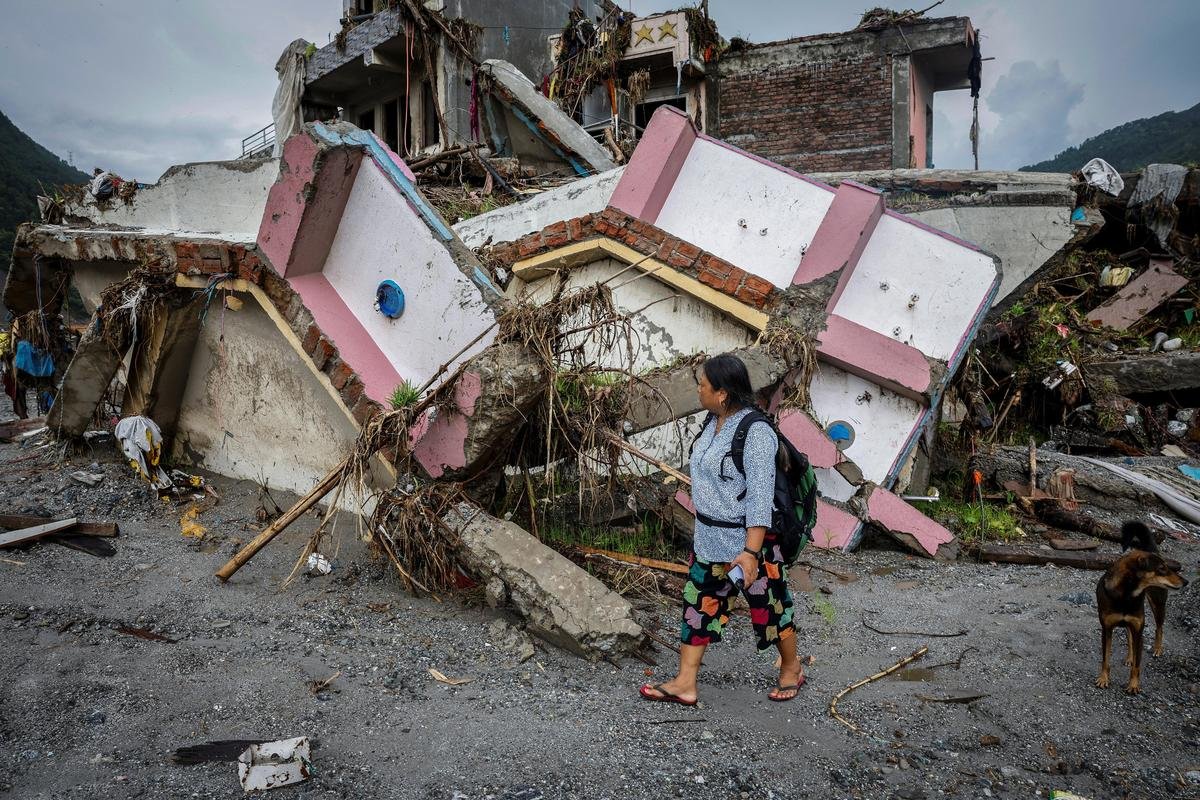
On the morning of August 26, the landscape of Nepal’s Rasuwa district changed within minutes. High in the Himalayas, a mass of ice and rock broke loose, sending a sudden and violent rush of water, mud and debris down the Lhende Khola River. The torrent tore through valleys, destroying homes, settlements and vital infrastructure before reaching the Nepal-China border. More than 1,400 people were killed, while thousands more were left missing in the aftermath.
A study released on September 17 by World Weather Attribution, a group of climate scientists who examine the links between extreme weather and climate change, offers further insight into what may have contributed to the disaster. The researchers found that human-induced climate change likely played a role in creating the conditions that made the rock-and-ice avalanche and the resulting floods possible.
Nepal’s Foreign Minister, Shisir Khanal, has called for climate justice and urged the world’s wealthiest economies to help the country recover from the devastating floods. Nepal is now seeking $20 million in climate compensation, arguing that the funds are needed to support recovery and rebuilding in the communities affected by the disaster.
Defining environmental damage remains a complex issue. International law does not provide a universally agreed threshold for determining when environmental harm is serious enough to trigger liability. However, State practice, decisions of international tribunals and the writings of legal scholars generally point towards a requirement that the damage be significant or substantial before State responsibility can arise.
It is a well-established principle of international law that a State is responsible for its internationally wrongful acts. This principle is reflected in Article 1 of the ILC Articles on the Responsibility of States for Internationally Wrongful Acts (2001). In the Trail Smelter case, the tribunal held that the injury had to have “serious consequences” before it could justify a claim. A similar idea appeared in Nauru’s claim against Australia, where Nauru relied on a general obligation not to alter the condition of its territory in a way that would cause “irreparable damage to, or substantially prejudice” the legal interests of another State. A related approach was also reflected in Hungary’s original application in the Gabčíkovo-Nagymaros Project case. In April 2002, the Marshall Islands Nuclear Claims Tribunal awarded US$324,949,311 to the people of Enewetak as a “just and adequate” settlement for damage to their land caused by the United States’ nuclear testing programme between 1946 and 1958.
The question of responsibility for environmental harm is not new. States have recognised for decades that existing rules do not adequately address situations in which environmental damage crosses borders. The Stockholm Declaration of 1972 was an early acknowledgment of this gap, calling for further development of international rules on liability and compensation for those affected by pollution and other environmental harm originating within a state’s jurisdiction. Later developments followed a similar path. The 1982 World Charter for Nature placed greater emphasis on restoring degraded environments and ensuring access to remedies for those whose environment had been damaged.
By the time of the Rio Declaration in 1992, however, there was still no clear international regime for compensation. Instead, the Declaration placed primary responsibility on states to develop domestic rules on liability and compensation, while encouraging further international cooperation on transboundary environmental harm. This cautious approach reflected a broader reluctance among states to accept international rules that could expose them to significant financial obligations—a concern that continues to shape debates over climate-related loss and damage today. The 2015 Paris Agreement was the first climate change treaty to include a provision addressing “loss and damage associated with the adverse effects of climate change, including extreme weather events and slow onset events.”
The evolution of international environmental law shows a continuing tension between recognising that states can be responsible for environmental harm and their reluctance to accept clear obligations to compensate those affected. Nepal’s claim therefore sits at the intersection of established principles of State responsibility, evolving scientific evidence and an international climate regime that has deliberately left the question of liability unresolved.