
Abstract
AI makes a revolutionary change in every field whether it’s field of technology, artistic work, web design etc. It makes an impact, In field of law it assist lawyers in their works, make their work easier but there is also many complications of using AI in the field of law, It sometimes give wrong or self-made judgement with wrong citations so, using it needs cross-checking. In this article we can delve into some important questions that can it thinks like human or whether it needs regulations, its limitations. It like more to transform the legal profession than eliminate that. However, it needs to be regulated ensure verification so technological progress doesn’t undermine the rule of law.
Introduction
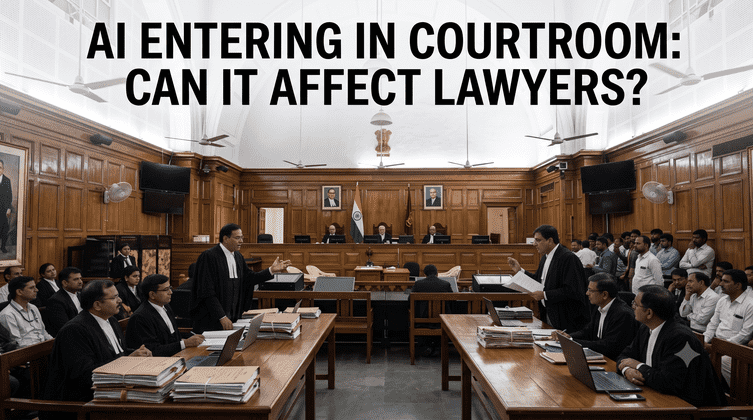
AI is now using in every field it takes many position in various fields like image generation and video generation, now become easier because of Ai so, question raises that it can affects lawyer.
In the field of lawyer there is not only work of text generation or searching something.
Courts and legal institutions are already exploring AI-assisted tools for translation, transcription, case management and legal research.
In India, the Supreme Court has supported technological initiatives such as SUVAS (Supreme Court Vidhik Anuvaad Software), which assists in translating judicial documents, and SUPACE (Supreme Court Portal for Assistance in Court Efficiency), which was developed to assist judicial research and efficiency. [1]
In lawyer’s work there is various types of work like client handling, drafting agreement, contracts, research case law etc.
So, replacing the lawyers isn’t possible on all cases but some areas like searching case laws and standardization of drafting or finding information about case laws make easier with the use of AI.
Growing role of AI in Indian Legal System
Legal work includes various work like exploring case laws, making arguments, hear facts from client and draft them, advice clients etc. AI can assist in many of these works, some assist in works like preparing counter arguments, searching case laws and summarize lengthy documents.
For example- A person is preparing a contractual dispute so, AI can assist him finding relevant clauses, making important chronology of that events.
By using this a lawyer can saves time in preparing or finding that tasks. Instead they use their time in client’s communication and preparing greater strategy for arguments.
However, Assisting or Taking help is different from completely generated work, there can incorrect case laws or information that need to be verified before using any statutes or judgements.
The Indian judiciary’s use of technology also demonstrates that AI need not be viewed exclusively as a threat to the legal profession.
Official government information has identified applications including judicial translation, transcription, legal research assistance and process automation. [2] These functions support the administration of justice without establishing that human legal professionals have become unnecessary.
Can AI actually think like a lawyer?
Ai is derived by algorithms and it thinks according to it, In some aspects it can better perform than humans but giving legal explanation is different from solving the client cases,
In client cases, lawyers have to handle many things like
- hearing facts,
- maintain emotional connection,
- draft their facts,
- make physical case documents
All these works need strategy and judgement so,
AI can generally help but not do these all these works, so it assists lawyers not do their work.
The problem of ‘’AI hallucination’’
The problem with the use of Ai in the field of law is,
like the main problem is inaccurate information Ai gives answer by its artificial learning and by searching some online websites but that’s may be incorrect.
AI-related errors can affect the integrity of adjudication itself. The Court also directed the Bar Council of India to constitute a committee to consider guiding principles and disciplinary consequences concerning the submission of fabricated legal authorities. [3]
See there are many instances where many lawyers use AI to search case laws for assisting in their case and they also present the same case law in the case file, while being checked by justice;
they find incorrect their citations and case be artificially generated so, a lawyer must be checked every time they are searching case laws.
Confidentiality and Client’s Information
This raises questions about the use of ai while taking help in case law that, because some AI models store information to train their models.
The Digital Personal Data Protection Act 2023 provides a statutory framework concerning the processing of digital personal data in India.[4] Its application to a particular AI-assisted legal activity depends on the nature of the data, the parties involved, the applicable provisions and the relevant commencement arrangements. The Act should not be treated as a complete code governing every question of legal confidentiality or AI accountability.
The constitutional right to privacy is also relevant. In K S Puttaswamy v Union of India, the Supreme Court recognised privacy as a fundamental right under the Constitution.[5] Although the judgment did not specifically determine how lawyers should use generative AI, it provides important constitutional context for protecting personal information.
So, anyone who uses while taking help in cases must keep in mind while using it –
- That use Ai premium models that specifically says that they not store information to train their models.
- Be cautious while uploading sensitive information on the Ai tools.
- If you seriously want help in that cases, don’t post name or his documents that are seriously important to that person.
Can AI Replace Advocacy?
This is the main question we are finding that, in advocacy, there are a lot of works understanding client’s facts not only its facts but also its emotional state at that point of time, give them direction, what we now doing in cases and what the result we can get.
In advocate’s work there is also argument between lawyers in cases also sometimes debate between them ultimately, we should decide case with human beings as a central role.
So, AI can assist in works by finding information and many things but not argument or debate in court, there must be need of lawyers for solving disputes between person. The central challenge is not compete with the AI but it has to use while maintaining professional ethics, morality that legal practice demands.
AI and Access to Justice
There is not only question of problem with AI but it can also make access to justice for ordinary citizens easier.
For instance, AI can help to access justice for understanding the citizens their basic legal rights, In India where legal consultation is expensive so AI tools can make easier to accessible justice for citizens.
Legal consultation with AI can also not be mistaken for consultation with professionals because AI can also make mistakes as we know so, legal consultation with professional must be necessary before starting any legal procedures.
Limits of AI in Courtroom Advocacy and Client Representation
In a courtroom there is not only work of providing evidence or documents, there is a multiple works like arguments, giving counter-questions asked by the judges also asking cross question with the accused and many more…
A human lawyer can handle client’s ask their situation, if it’s serious, lawyers can understand and assure client’s.
Also, AI can generate documents or assist in cross questions, however generated responses can’t replace the practical consequences of that matter.
An advocate has also presented the disciplinary and standard ethics. Merely, by producing documents and give a response can’t make him a professional advocate.
The Advocates Act 1961 and the regulatory framework governing advocates remain important when determining who may practice law and what professional obligations apply. [6]
The distinction is not only about technological advancement and outdated human profession. It is about legal work that should perform in the courtroom and AI is a tool that assists in the legal work which must exercise judgement and accept responsibility in legal system.
Towards responsible regulation of AI in Law
The prohibition of usage of AI is not simply a solution of its problems, there should be regulations of AI platforms, a blanket ban can disregard the problem of AI.
There should be run educational programs in courts where lawyers should be given information about how to use AI in their work and about posting a confidential information.
There should also be human verification of data that what they assisting in their work, simply generated responses shouldn’t be used in it.
Also, there should be designed disclosure requirements by the courts so, there must be proper disclosure of filing of documents so this can improve accountability without unnecessary procedurals delays.
The goal should be protection of litigants while responsible adoption.
Conclusion
Artificial intelligence is just changing all the spheres of work, though in our legal field it can assist us with many works, it doesn’t mean that it can replace their work. AI has to be seen as a friend who helps in our work not enemy that takes our position, courts and experts must conduct seminars for understand the people its value and usage.
At The same time, AI introduces serious risks relating to fabricated authorities, inaccurate advice, confidentiality and accountability. The Supreme Court’s decision in Pooja Ramesh Singh v Jammu and Kashmir Bank Ltd illustrates why unverified AI-generated legal material cannot be allowed to undermine judicial decision-making.
So, by this article we can understand that it is not replace ourselves but it usage needs importance because of its vast capability to search and generated things in second but assistance never replace our work so, it should be use with verification not like in a copy-paste way.
Endnotes
[1] Supreme Court of India, Landmark Judgment Summaries and Ministry of Law and Justice, Government of India, ‘Use of Artificial Intelligence in Supreme Court’ (25 July 2025).
[2] Ministry of Law and Justice, Government of India, ‘Use of Artificial Intelligence in Supreme Court’ (25 July 2025).
[3] Pooja Ramesh Singh v Jammu and Kashmir Bank Ltd 2026 INSC 668 (Supreme Court of India, 2 July 2026).
[4] Digital Personal Data Protection Act 2023.
[5] K S Puttaswamy v Union of India (2017) 10 SCC 1.
[6] Advocates Act 1961, ss 7, 35 and 49.