
Micro, Small, and Medium Enterprises (MSMEs) are an important part of India’s economy, whether measured in terms of their contribution in the country’s employment, production or economic situation. The Micro, Small And Medium Enterprises Development Act, 2006 serves as the primary legislation for their governance. Its importance in the domain of Alternative Dispute Resolution (ADR) can be ascertained through the dedicated dispute resolution mechanism for MSME enterprises, especially for speedy resolution of payment related dispute.The detailed process is outlined in Chapter-V, Section 15-23 of the 2006 Act.
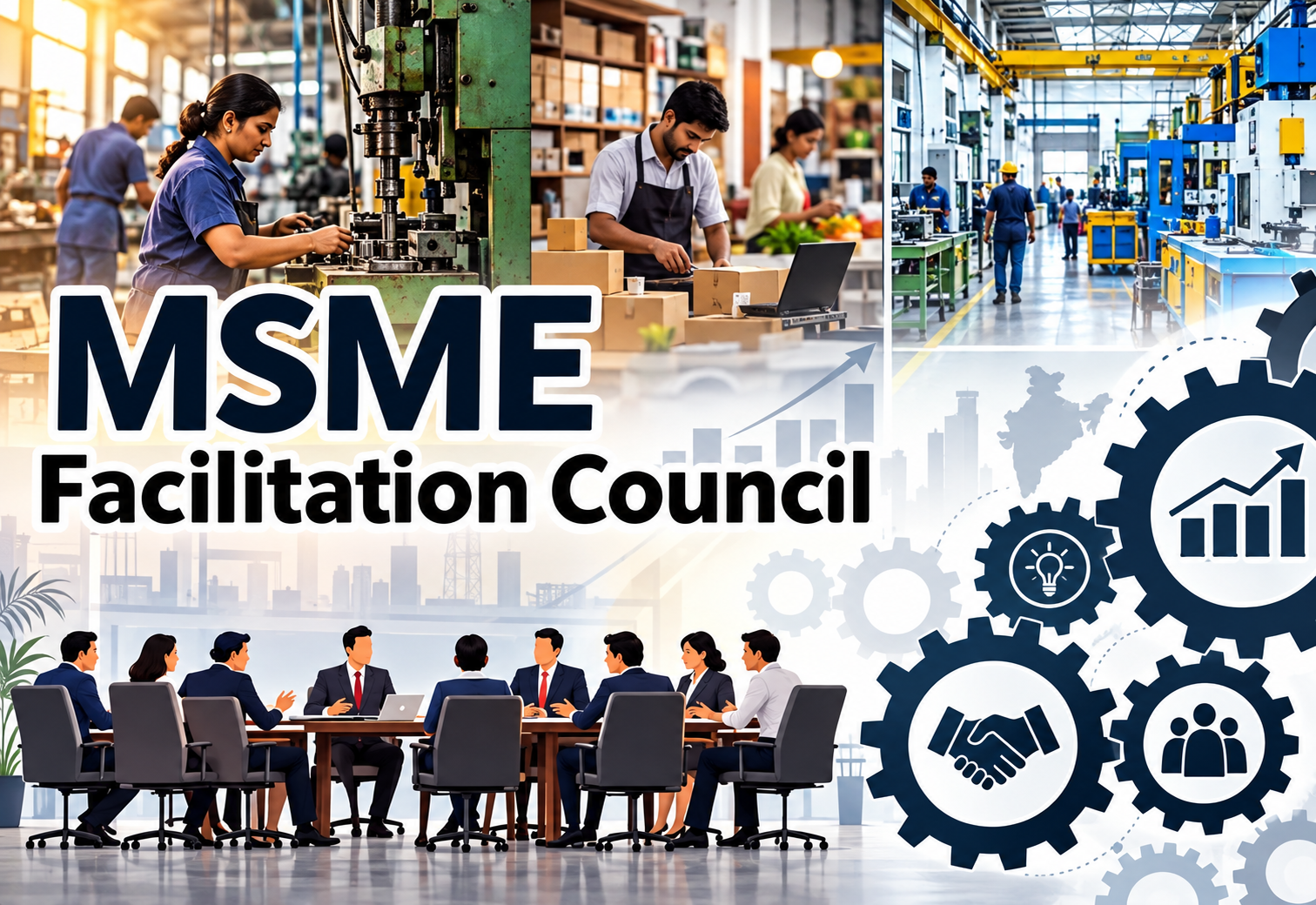
According to Section 15, it gives buyers a maximum of 45 days to pay a seller recognized as an MSME under the aforesaid Act. If that window is missed, the seller becomes entitled to compound interest on the outstanding amount, calculated at three times the bank rate notified by the RBI, running from the date payment was due. Compounded at that rate, delayed payments can become expensive quickly, which is presumably the point. To make this right enforceable rather than a mere promise on paper, the Act has also established a dedicated forum known as the Micro and Small Enterprises Facilitation Council. Its primary purpose is to resolve payment related and other disputes of MSMEs without requiring them to go through the regular judicial process. Section 18 sets out how this Council is constituted and how it functions.
The process before the Council is peculiar in the sense that it combines two Alternative Dispute Resolution mechanisms, namely, conciliation and arbitration, which are usually treated separately, into a single continuous track:
- Section 18(2): According to this sub-section, once a complaint is filed, the Council can either conduct conciliation itself or hand the matter to another institution or centre offering ADR services. Either way, Sections 65 to 81 of the Arbitration and Conciliation Act, 1996 shall apply and treated as if the process of conciliation had been initiated under Part III of that Act.
- Section 18(3): If that above mentioned conciliation fails and ends without settlement, the Council can take up the same dispute for arbitration itself, or refer it out elsewhere. The Arbitration and Conciliation Act, 1996 then governs the proceedings as if there were a proper arbitration agreement under Section 7(1) of that Act between the parties, whether or not actually signed.
Section 18(4) fixes the Council’s jurisdiction based on where the supplier or seller is located, not the buyer, a deliberate choice to make the remedy easier and cheaper for MSMEs to use. The Act also requires the Council to have at least three and at most five members for adjudication of all disputes. If either party wants to challenge the council’s award before a court, they first have to deposit 75 percent of the amount of the decree as stipulated. That deposit requirement is placed in order to discourage any of the parties from filing frivolous appeals meant purely to delay its execution.
The purpose of establishing a separate Alternative Dispute Resolution Body under the MSMED Act, 2006, was to provide an exclusive mechanism for resolving grievances for MSMEs, thereby minimizing any disruption to their routine business activities. That said, this hasn’t always sat comfortably alongside the regular ADR framework most commercial contracts already rely on. Section 18 of the aforesaid Act gives the Council an overriding effect over other laws, stating that “the provisions of sections 15 to 23 shall have effect notwithstanding anything inconsistent therewith contained in any other law in force at the time.” A prima facie reading would reveal the Council is the only forum for MSME disputes, regardless of whatever dispute resolution clause the parties negotiated into their own contract.
This raises a question that goes beyond mere statutory interpretation: does the MSMED Act truly oust party autonomy altogether, or does it only displace an arbitration clause when actually invoked to defeat the seller’s claim before the Council? The answer matters practically. If the Council’s jurisdiction is treated as absolute, buyers lose the benefit of any dispute resolution mechanism they may have specifically negotiated for, however sophisticated. If it is treated as conditional, the protective purpose of the Act, insulating MSMEs from delay and forum-shopping by larger buyers, is diluted. The case law below does not speak in one voice on this question.
The courts have given this provision a variable interpretation at several instances. In Gujarat State Civil Supplies … vs Mahakali Foods Pvt. Ltd. (Unit 2) on 31 October, 2022 the Supreme Court came down firmly in favour of the Council’s authority, holding that its jurisdiction under Section 18 survives even where the parties already have a separate or specific arbitration agreement in place. It was held that the provisions of the special statute would override the provisions of the general statute. Therefore, the provisions of Chapter-V of the MSMED Act, 2006 have an effect overriding the provisions of the Arbitration Act, 1996. This case is generally treated as the anchor authority for the Council’s overriding powers, and the one most frequently cited whenever a buyer argues that a private arbitration clause should take precedence instead.
Several High Courts have supplemented this interpretation with different line of reasoning. In BSNL v. Maharashtra Micro and Small Enterprises Facilitation Council, the Bombay High Court took a more reconciliatory approach, holding that an existing arbitration agreement doesn’t stop working just because of the overriding clause, since that clause only overrides what’s genuinely inconsistent with it, and there’s no real inconsistency between arbitration conducted by the Council under Section 18 and arbitration under a separate clause, since both are ultimately governed by the same Arbitration and Conciliation Act, 1996. M/s. Bharat Heavy Electricals Limited v. State of U.P. & Ors. went a different way, with a Division Bench of the Allahabad High Court holding that Section 18(4) empowers the Facilitation Council to act as arbitrator regardless of any existing arbitration agreement, meaning the Council cannot be excluded by private agreement. This effectively reiterated the view of the Supreme Court with regard to this issue. In another matter of Silpi Industries v. Kerala State Road Transport Corporation & Anr., the Supreme Court dealt with the issue of representation of buyer before the Micro and Small Enterprises Council. Though it was reiterated that if the seller is covered by definition under micro, small and medium enterprises, seller may approach the Facilitation Council for making claims under the provisions of Micro, Small and Medium Enterprises Development Act, 2006, yet it was said that even the buyer, if any claim is there, can very well be subjected to the jurisdiction before the Council and make its claim/counter claim as otherwise it will defeat the very objects of the Act which is a beneficial legislation to micro, small and medium enterprises. It was finally held that the right of a seller who is covered by the MSMED Act, 2006 to approach the Facilitation Council is not extinguished merely by the existence of a private arbitration agreement. However, an important pre-requisite for availing the remedy as provided under this Act is that the seller should have registered under the provisions of the Act, as on the date of entering into the contract which is the subject matter of the dispute.
Therefore, as summarized from the aforementioned decisions, the overall stance of courts is towards supporting the Micro and Small Enterprises Facilitation Council for adjudicating disputes concerning MSMEs, even when there is an existing arbitration agreement or other such arrangements in place. This is done in accordance with the overriding clause under Section 18 of the Micro, Small and Medium Enterprises Development Act, 2006 and general legal principles supporting specific statutes over legislation of a general nature. However, the entire process as laid down under Section 15-23 of the aforesaid Act is contingent on the seller’s choice. The seller who is categorized as an MSME has a voluntary option to approach the Micro and Small Enterprises Facilitation Council or exercise any other choice which is considered to be suitable and beneficial.
The primary objective of establishing the Micro and Small Enterprises Facilitation Council under the MSMED Act, 2006, is to expedite and streamline the administration of justice and the resolution of cases. The ultimate goal of Alternative Dispute Resolution System provided in the Act is to alleviate the burden on the regular courts. Though it may appear at several instances that it seems to conflict with the regular mechanism under the Arbitration and Conciliation Act, 1996, yet in practical terms, it is only a specialized replication of the system outlined in the Act for the MSME sector. Although the courts have repeatedly emphasized the supremacy of this council for disputes concerning MSME parties, but they have continue to acknowledge the need for respecting individual parties’ choices regarding Arbitration Agreements and dispute resolution. Nevertheless, this mechanism continues to be a popular choice for Enterprises within the MSME sector.