
Introduction
When the General Debate in the 81st session of the United Nations General Assembly closed on 28th September 2026, artificial intelligence (“AI”) had been raised by 128 delegations, up from only five delegations four years ago. That is more than the number for climate change or human rights. The same week showcased a fragmentation: Secretary-General António Guterres and the European Union called for international rules, while President Trump argued that AI innovation should not be constrained by them. Guterres located the problem in power: across the four tests (AI, climate change, war and inequality) facing the world, AI among them, “the decisive issue is power”.
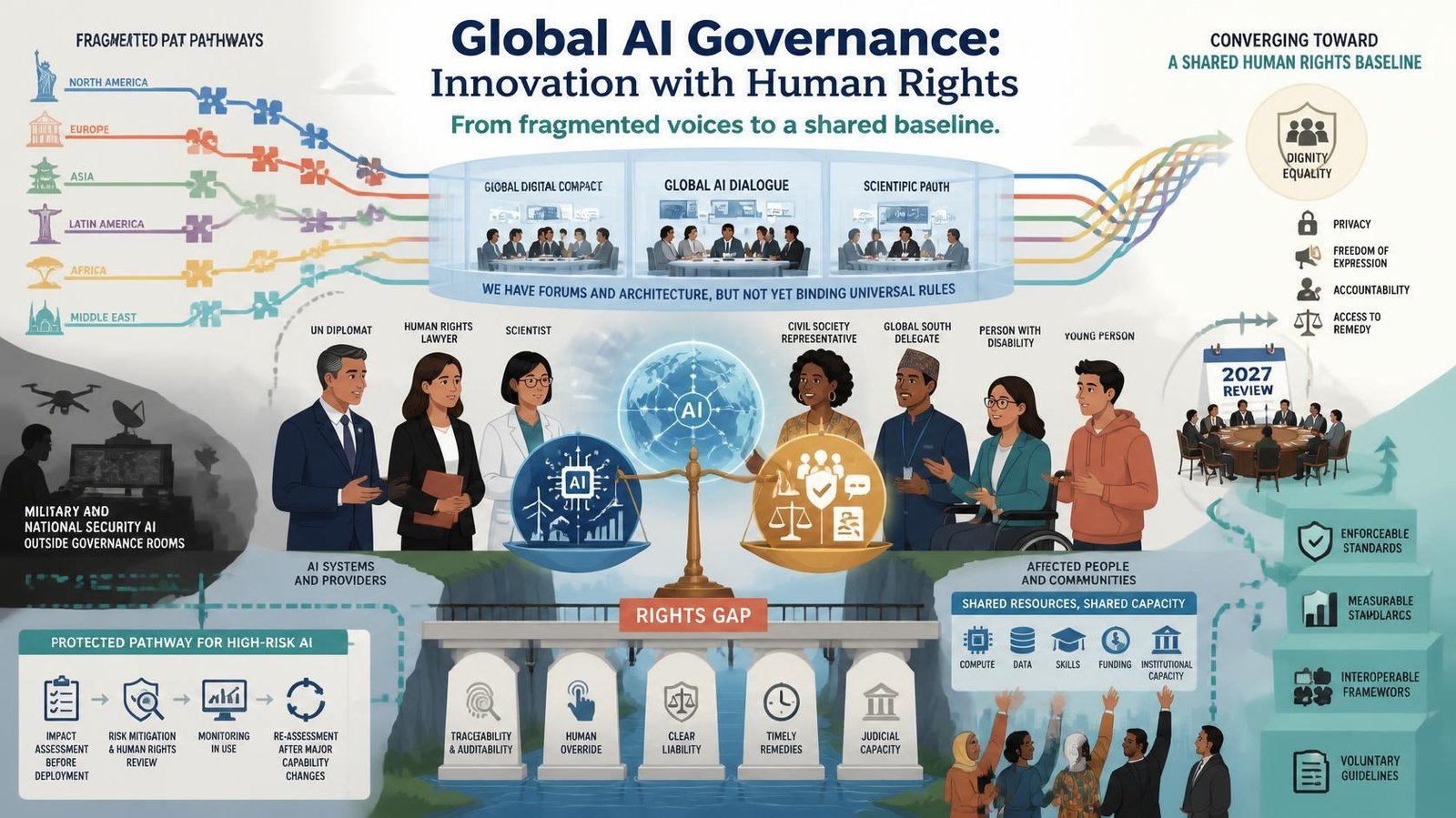
The United Nations has built the rooms for AI governance but no binding universal rule on AI exists. The treaty which is binding, the Council of Europe’s Framework Convention on Artificial Intelligence and Human Rights, Democracy and the Rule of Law, has one ratification from the European Union, and is not yet in force. A human-rights-based framework will depend less on a future treaty than on whether the 2027 review of the Global Digital Compact turns current guidelines into a baseline substantive enough to harden into enforceable standards for all states, and not just AI superpowers.
The Architecture: Rooms without Rules
The Global Digital Compact, adopted at the Summit of the Future in September 2024, committed states to establish an Independent International Scientific Panel and a global dialogue on AI. Resolution 79/325, adopted on 26th August 2025, supplied their terms of reference. The scientific panel has forty experts and issues an annual report that the resolution describes as policy-relevant but “non-prescriptive”, and both bodies are confined to the non-military domain.
The first UN Global Dialogue met in Geneva on 6th and 7th July 2026, with 163 countries represented. It produced a forum and not obligations. The dialogue is not a negotiating forum: it ends in a co-chair summary, which lets every country take part equally but binds no one.
Two design choices matter. “Non-prescriptive” means the panel cannot recommend rules. The military carve-out, which excludes military uses of AI from both bodies, takes the uses where risks to life and equality are gravest out of this track. The Council of Europe’s treaty Framework Convention on Artificial Intelligence, repeats the pattern: it excludes national defence [Article 3(4)] and does not require parties to apply it to national security activities. Therefore, state security is where the rights gap is widest.
The Rights Gap: Translation, Not Absence
AI does not arrive in a legal vacuum. The Charter of the United Nations makes human rights a purpose of the Organisation, the Universal Declaration supplies the vocabulary of dignity and equality, and the International Covenant on Civil and Political Rights (“ICCPR”) binds its parties on privacy (Article 17), expression (Article 19) and non-discrimination (Article 26). Geneva participants stressed that the international human rights framework applies fully to AI, and the High Commissioner’s June 2026 report, A/HRC/62/33 (an advance unedited version), frames States’ duties to respect, protect and fulfil rights across the AI lifecycle through human rights due diligence.
The treaties were drafted around state actors and human decision-makers, and three frictions follow.
Firstly, Attribution: obligations run to States and reach private developers only through the State’s duty to protect. A model trained in one country, deployed by a firm in a second and affecting people in a third tests the limits of Article 2(1) of the ICCPR, which secures rights to individuals “within its territory and subject to its jurisdiction”. The Human Rights Committee has read the provision broadly by covering anyone “within the power or effective control” of a State Parties even outside its territory (para 10). This narrows the friction, but whether the diffuse effects of a privately deployed model amount to such control remain unsettled.
Secondly, Opacity: the right to an effective remedy under Article 2(3) presupposes that a person can know a decision was automated and contest it.
Thirdly, Autonomy: agentic systems dilute the identifiable human decision-maker on whom responsibility ordinarily rests.
Participants converged on five elements of accountability: traceability of systems, an identifiable human empowered to override or stop them, a clear location of liability, timely remedies, and judicial capacity. The forum, liability for transnational harm, remains unresolved. Binding law would help: the Council of Europe Convention requires remedies, procedural safeguards and risk and impact management (Articles 14 to 16). But it leaves implementation to each party and is not yet in force, and participants themselves called interoperability (rules that can work together across jurisdictions without being identical).
Who Writes The Rules? The Global South Problem
The 2024 high-level advisory body on AI found that only seven countries were party to all the prominent non-UN AI governance initiatives it surveyed, while 118, mostly in the Global South, were party to none. The dialogue was built to change this by giving every state a seat. Written submissions warned that developing countries, children, communities, women and persons with disabilities remain under-represented. Delegations insisted on being active participants in AI’s designs, not passive recipients, and the widening divide in compute, data, skills and institutions was the concern raised across regions.
The process is resource-constrained: the Co-Chairs record that preparations ran on limited resources and goodwill. Interoperability is to be anchored in technical standards, and participants asked for support to enable developing countries to join in settling them.
The pattern depicts wide endorsement, but thin obligation. The February 2026 AI Impact Summit produced the New Delhi Declaration, endorsed by 92 countries and international organisations according to the Government of India, illustrates the same pattern , but its commitments are voluntary, non-binding and silent on military uses.
Using The 2027 Review
The Global Digital Compact provides for a high-level review during the United Nations General Assembly’s 82nd session, with modalities left to co-facilitators appointed by the President of the United Nations General Assembly. Its scope is observed narrowly and the review just restates the Compact. Research on the global governance of AI illustrates a fragmented regime as multifaceted and cautions that locking in an inadequate centralised structure may be worse than fragmentation. This recommends that the review can be used in a way to connect and test existing bodies rather than designing a body.
Resolution 79/325 directs the Co-Chairs of the Second Dialogue (New York, 3rd – 4th May 2027) to hold intergovernmental consultations to agree common understandings on priority areas of international AI governance as an input. This is softer than an earlier draft, which envisaged negotiating a declaration. The outcome being soft is not in itself a defect. Abbott and Snidal show that soft law is easier to achieve, copes better with uncertainty and infringes less on sovereignty. But risk lies everywhere. Non-binding instruments increasingly play the role of binding law, such as the UN Guiding Principles on Business and Human Rights, which were hardened into mandatory due diligence legislation within a decade. This is to be applied to AI governance and the 2027 review. With this in mind, three moves would give it substance.
Firstly, the review should assess the panel and dialogue against the Global Digital Compact’s human rights commitments, not merely recount them.
Secondly, the “common understandings” should be built on the Geneva cluster’s five accountability elements identified in Geneva, together with human rights impact assessments before high-risk systems are deployed and again after material capability changes. Both surfaced in the dialogue and track the due-diligence approach of A/HRC/62/33. Bonnitcha and McCorquodale show that the UN Guiding Principles on Business and Human Rights conflate two ideas: due diligence as a way of protecting rights-holders and due diligence as a way for firms to manage their own financial risk. The baseline should stipulate that impact assessments measure risk to people, not risk to the developer, so that the hardened structure does not inculcate the same confusion. States would report through existing machinery, such as the Universal Periodic Review and the treaty bodies.
Thirdly, the co-chairs ask for predictable funding from the outset of preparations for the second dialogue, while the resolution leaves developing-country participation to voluntary contributions. If the review renews the mandates, it should attach funded travel and capacity support, so reporting duties do not burden those least able to meet them.
Conclusion
The strength of the United Nations lies in its universality, not in enforcing decisions. It cannot compel powerful States. It can make distance between rights and practice visible and measurable. This can happen using a soft baseline, which will be hardened and verified during the 2027 review in compliance with the Human Rights standards of the Global Digital Compact. Moreover, this can be assisted by the involvement of the developing countries. The second dialogue in May 2027, and a new Secretary-General taking office on 1st January 2027, are the moments to test whether it results in rules or a voice for those who will live under them.