
Introduction
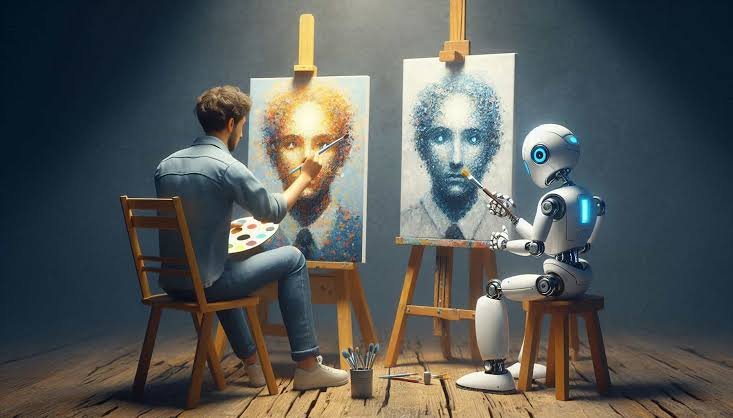
Artificial Intelligence is now more than just a means of analysing data; it is creating paintings, music, and literature. Tools like Midjourney and DALL-E allow anyone to generate art within seconds. This raises a fundamental legal question in India: can AI-generated art be copyrighted? And if so, who will be recognised as the author the AI or the human user?
Legal Framework of the Copyright Act, 1957
The Indian Copyright Act, 1957 was enacted in an era of human creativity. Section 2(d) defines the ‘author’ of an artistic work as the person who creates it, and Section 17 recognises the author as the first owner of copyright. The use of the word ‘person’ clearly points to a human being. Since the Act does not recognise a non-human entity as an author, it creates a legal vacuum for AI-generated creations.
The Indian Experience: The Raghav Case
India’s first test case arose when an applicant sought copyright for an artwork created using the AI tool ‘Raghav’. He claimed himself as the author and the AI as co-author. The Copyright Office initially objected to recognising AI as a co-author. After hearing, the Office granted registration recognising the human as the author while merely noting the AI’s contribution. This clarified that while AI assistance is permissible, authorship cannot vest in the AI itself.
Global Perspective
India shares the same viewpoint with the USA. The US District Court ruling in Thaler v. Perlmutter (2023) held that works need human authorship to qualify for copyright and thus refused to grant copyright to the work of AI because it had no human author. However, the UK on the other hand under Section 9(3) of the Copyright, Designs and Patents Act, 1988 (CDPA, 1988) gives copyright in respect of computer-generated works to the person who makes the necessary arrangements. Currently, India follows the less flexible US doctrine.
Challenges and way forward
In my opinion, India should not adopt the US stance on human authorship. It protects creativity; however, it fails to recognise the large investments made in AI systems. Also, the UK approach does not fit India’s needs. Therefore, India needs its own framework whereby an individual who exercises creativity in prompting, choosing and improving the output is treated as an author, but only for a limited term.
The biggest hurdle is to decide what level of human involvement qualifies for creative creation. When a human operator inputs something for AI to work with, is it enough as a show of creativity? Therefore, India needs to amend its laws to clarify the issue of: (a) are AI-assisted works eligible for any protection, and (b) who holds the rights the developer or consumer, or both?
Conclusion
Copyright law was designed to provide incentives for human innovation, both Indian jurisprudence and US law agree that AI cannot be credited with authorship. To spur innovation, India needs to change its Copyright Act so that the creator of AI is defined as the author.