
Introduction
For decades, much of the developing world has occupied an uncomfortable position in international governance. It has had a seat at the table, but not always an equal hand in writing the rules.
The distinction matters.
Countries of the Global South have participated in the United Nations, the World Trade Organization, the International Monetary Fund, the World Bank and numerous multilateral negotiations. They have signed treaties, implemented international standards and contributed to international institutions. Yet participation has not always translated into an equivalent capacity to determine the rules, standards and institutional priorities that shape the international system.
The 18th BRICS Summit, held in New Delhi from 12 to 13 September 2026, brought this longstanding imbalance into sharper focus. The summit marked twenty years of BRICS cooperation and was held under India’s 2026 chairship. The New Delhi BRICS Leaders’ Declaration placed considerable emphasis on strengthening the voice and representation of emerging markets and developing countries in global decision-making.
Prime Minister Narendra Modi put the issue more directly. In his remarks on inclusive global governance, he argued that the Global South should move from being a “rule-taker” to a “rule-shaper” and linked that objective to negotiation skills, practical training and legal expertise for diplomats and policymakers from developing countries. He also called for a transformation from a “pyramid of privilege” to a “platform of partnership.”
The formulation deserves attention because it raises a question that lies at the intersection of international law, diplomacy and institutional design:
What does meaningful participation in global governance mean if states have representation but lack the institutional, financial, technological and legal capacity to influence the rules being made?
That is where New Delhi becomes significant.
The Pen Matters More Than the Seat
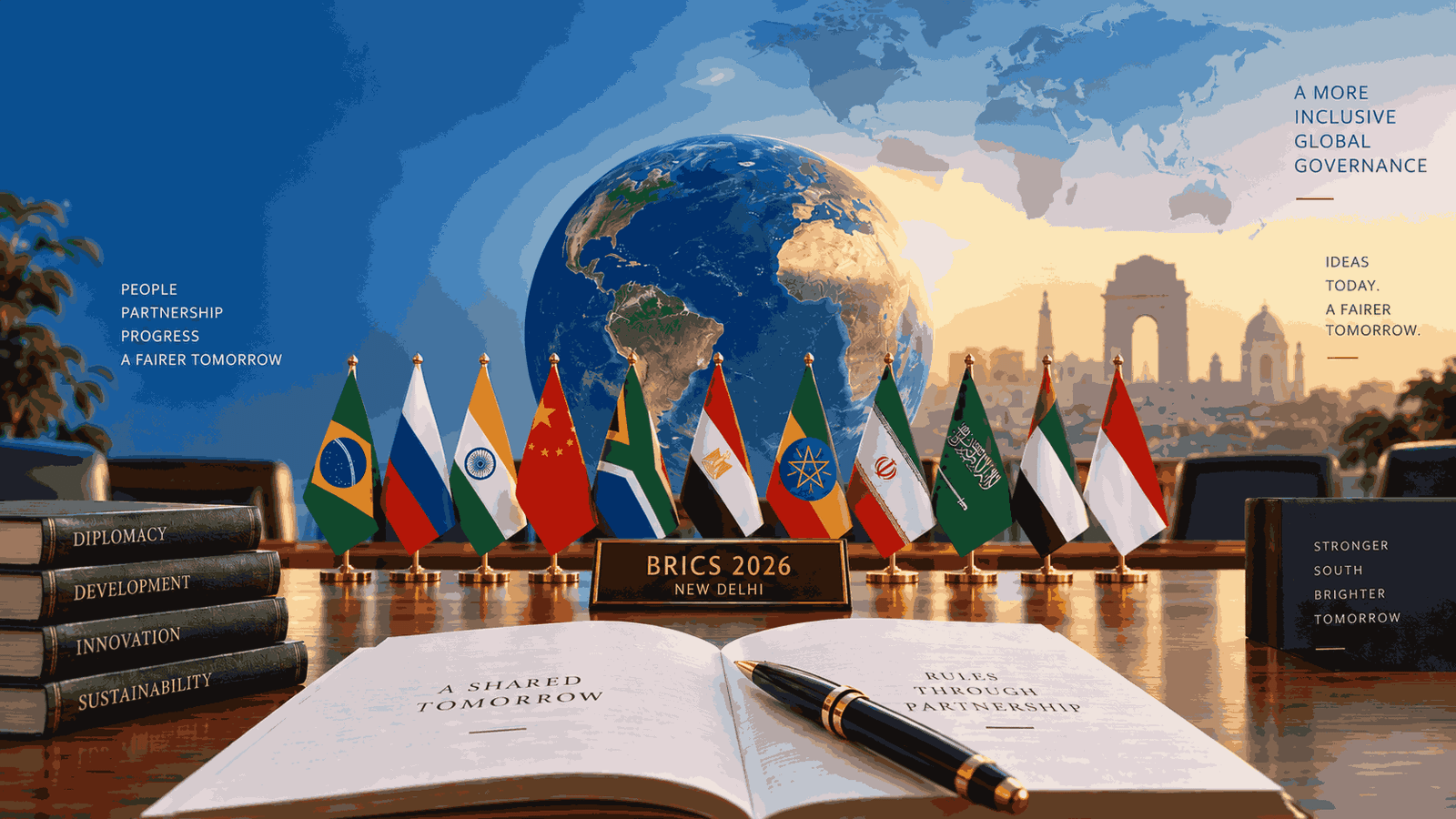
BRICS has changed considerably since its original BRIC formulation. The present grouping includes Brazil, Russia, India, China, South Africa, Egypt, Ethiopia, Iran, the United Arab Emirates, Indonesia and Saudi Arabia.
But numerical expansion does not, by itself, create international legal influence.
The more important question is whether political cooperation can be converted into institutional capacity.
This concern was visible in India’s proposal for a BRICS Continuity and Implementation Mechanism. Prime Minister Modi proposed using the BRICS Troika, comprising the previous, current and incoming chairs, to follow up on initiatives and outcomes. He also proposed a secure digital repository containing information on decisions, responsible institutions, timelines and implementation status.
The New Delhi Declaration subsequently welcomed progress towards a BRICS Online Archival Database and called for continuity and long-term institutional development.
These may appear to be questions of administration. They are more consequential than that.
International institutions acquire influence when political commitments are converted into repeatable institutional practices. Continuity creates institutional memory. Clear responsibilities make implementation traceable. Archives preserve decisions beyond individual presidencies. Institutional mechanisms make political commitments capable of being assessed and carried forward.
This is particularly relevant because BRICS is not a treaty-based organisation comparable to the European Union or an international organisation established through a constituent treaty. Its declarations are primarily political instruments. They do not automatically create binding obligations under international law merely because leaders adopt them.
That distinction should not, however, be mistaken for institutional insignificance.
International legal development does not occur only through formally binding treaties. Negotiations, resolutions, declarations, institutional practice, common positions and repeated state conduct can all influence the development of international norms, depending upon their legal character and subsequent practice.
The more defensible proposition, therefore, is not that BRICS is becoming a constitutional order.
It is that BRICS is developing institutional practices through which emerging economies can coordinate positions, preserve collective decisions, develop technical capacity and carry common priorities into wider international negotiations.
That is an important form of rule-shaping.
The question after New Delhi is consequently not simply what the leaders agreed upon during two days. It is whether the institutional machinery created around those decisions survives the next chairship and becomes sufficiently durable to influence future negotiations.
The pen matters because it represents continuity, expertise and institutional capacity.
The Rules of Tomorrow Are Already Being Written
The significance of the New Delhi Summit also lies in the subjects around which BRICS is seeking deeper cooperation.
Artificial intelligence. Digital governance. Cybersecurity. Cross-border payments. Local-currency settlements. Development finance. Climate finance. Critical technologies. Supply chains.
These are not peripheral questions.
They concern the rules of the next phase of globalisation.
Artificial intelligence provides perhaps the clearest example.
AI systems may currently be developed disproportionately in technologically advanced economies, but their legal, economic and social consequences extend far beyond those jurisdictions. Questions concerning access to computing infrastructure, data, intellectual property, safety, accountability and technical standards will increasingly influence the policy space available to developing countries.
The New Delhi Declaration recognises this challenge and calls for international cooperation on AI that addresses safety, security, inclusiveness and reliability while paying particular attention to the needs of the Global South. It also records BRICS’ commitment to implementing its Leaders’ Statement on the global governance of AI.
This debate is already taking place beyond BRICS.
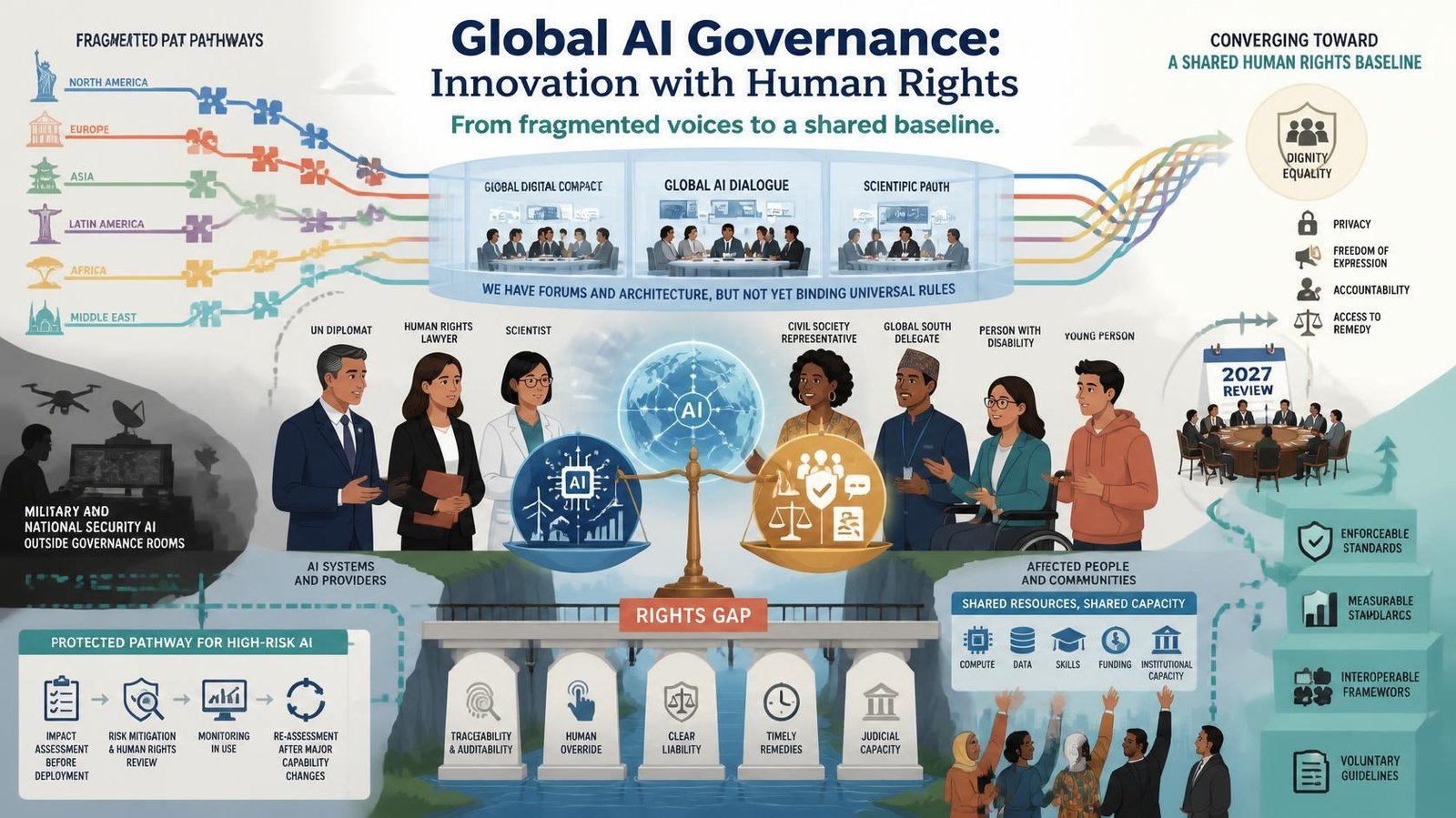
The United Nations Global Digital Compact calls for inclusive participation in digital governance and specifically recognises the need for developing countries to build capacity to access, develop, use and govern artificial intelligence. It also calls for international cooperation to promote compatibility between emerging AI governance frameworks.
The UN Global Dialogue on AI Governance provides another example. Established as a UN platform for governments and stakeholders to discuss international cooperation on AI governance, the Dialogue reflects a wider recognition that AI governance cannot be shaped solely by the jurisdictions possessing the most advanced technological capabilities.
The legal question is therefore becoming difficult to avoid:
Will developing countries primarily implement AI standards designed elsewhere, or will they possess sufficient capacity to participate in designing those standards?
The same problem exists in financial infrastructure.
The New Delhi Declaration records the work of the BRICS Payment Task Force on cross-border payment mechanisms, including interoperability of payment and messaging systems and discussions concerning the use of BRICS local currencies for trade settlements and investment. At the same time, it recognises that there is no one-size-fits-all approach and that national priorities must be respected.
That qualification is important.
Financial sovereignty does not necessarily require a common BRICS currency. A more immediate question is whether emerging economies can develop payment and settlement arrangements that give them greater choice and resilience in international transactions.
The same principle applies to development finance.
The New Development Bank has become one of the principal institutional expressions of BRICS financial cooperation. At the 2026 Summit, the Bank highlighted its continuing role in supporting sustainable development in BRICS and other emerging markets and developing countries. The BRICS-NDB Knowledge Portal, launched under India’s chairship, is intended to preserve development experiences, policy innovations and lessons from projects across member countries.
These developments demonstrate why the relationship between law and economics cannot be ignored.
Rules governing finance affect the practical policy space available to states. Rules governing technology influence access to innovation. Rules governing trade affect industrial development. Rules governing climate finance influence the conditions under which developing countries can pursue economic growth while meeting environmental commitments.
These are questions of sovereignty expressed through institutions.
Representation Is Also a Question of Institutional Power
The Global South’s demand for greater representation is not new.
It is visible in debates over the UN Security Council, the IMF quota and voting structure, the governance of the World Bank and the functioning of the multilateral trading system.
The New Delhi Declaration explicitly calls for greater participation and representation of emerging markets and developing countries in global decision-making structures. It also calls for reform of the Bretton Woods institutions so that their governance better reflects changes in the global economy.
The IMF provides a particularly useful illustration of why institutional representation matters.
The IMF’s current data on members’ quotas and voting power shows that quota shares are connected to voting power and institutional representation. The composition of these shares therefore has consequences beyond symbolism. It affects how states participate in the Fund’s decision-making architecture.
The issue is equally visible in trade law.
The WTO’s framework on Special and Differential Treatment recognises that developing countries receive particular rights and flexibilities within the multilateral trading system. These include longer implementation periods, measures intended to increase trading opportunities and assistance in building the capacity necessary to participate in WTO work and dispute settlement.
The WTO Enabling Clause provides a legal basis for differential and more favourable treatment of developing countries in specified circumstances.
But these provisions also reveal the larger problem.
Having a legal entitlement to special treatment is different from having the negotiating capacity to shape the rules under which international trade operates.
A state may formally possess a voice in a negotiating forum and still face significant constraints because of limited technical expertise, legal resources, institutional capacity or negotiating leverage.
That is why rule-shaping is ultimately a capacity question.
From Political Declaration to Institutional Discipline
There is, however, an important qualification.
BRICS cannot simply declare itself the representative of the entire Global South.
The Global South is neither a single legal entity nor a politically homogeneous constituency. Its members have different economic structures, development priorities, political systems, strategic interests and foreign-policy positions.
BRICS itself is equally diverse.
Its members do not agree on every geopolitical issue. Their relationships with other major powers differ. Their economic interests are not identical. Their domestic regulatory systems vary substantially.
The future significance of BRICS will therefore not depend on whether its members agree on everything.
It will depend on whether they can cooperate effectively on enough issues to develop durable institutions and common negotiating positions.
The New Delhi Summit provides several examples.
The BRICS Task Force on Growth and Development brings together questions of development models, development finance, digital transformation, artificial intelligence, structural reform and climate finance. The stated objective is also to inform BRICS engagement in multilateral forums.
The BRICS Multilateral Guarantees initiative represents another attempt to move from political coordination towards practical financial mechanisms. Its purpose is connected with mobilising private capital and reducing financing costs for development projects.
The BRICS-NDB Knowledge Portal similarly seeks to preserve institutional knowledge across successive chairships rather than allowing each presidency to begin from the same starting point.
India’s proposal for a Seafarers Emergency Support Network is another revealing example. Seafarers may appear to be a specialised maritime issue, but disruption to maritime transport can affect freight costs, supply chains, energy security and food prices. The proposal therefore connects protection of individuals with wider questions of maritime and economic resilience.
These initiatives suggest an important shift in the way global governance is being approached.
The discussion is increasingly moving from broad demands for fairness towards questions of institutional design, technical capacity, implementation and continuity.
That is a more difficult project.
It is also more relevant to international law.
A declaration does not automatically create international law. A political commitment does not become legally binding simply because states have endorsed it. The legal consequences depend upon the nature of the instrument, the intention of the parties, applicable treaty obligations, customary international law and subsequent state practice.
Yet political cooperation can generate institutional practice. Institutional practice can influence negotiations. Negotiations can produce agreements, standards and common positions. Repeated practice may then contribute to the development or interpretation of international legal norms where the relevant requirements of international law are satisfied.
The journey from political aspiration to legal consequence is therefore gradual.
New Delhi has not completed it.
It may, however, have made the journey more institutional.
The Real Test Begins After New Delhi
The significance of BRICS 2026 should not be reduced to the question of whether the grouping will replace the G7, the United Nations or the existing international financial architecture.
That is a much narrower question than the one raised by the summit itself.
The more important question is whether countries that have historically adapted to rules developed elsewhere can acquire enough collective capacity to participate meaningfully in developing the next generation of international rules.
That requires more than diplomatic solidarity.
It requires lawyers capable of understanding treaty-making, international institutional law and regulatory negotiations. It requires diplomats trained to negotiate increasingly technical arrangements. It requires economists who can design viable financial mechanisms. It requires technologists who can participate in international standard-setting. And it requires institutions capable of preserving decisions beyond the tenure of a single chair.
The UN Office for Digital and Emerging Technologies, for example, records the establishment and operationalisation of new international mechanisms for AI governance, including the Independent International Scientific Panel on AI and the Global Dialogue on AI Governance.
The significance of this development for the Global South is clear. International rule-making increasingly takes place in technical forums where legal expertise alone is insufficient. Effective participation requires a combination of legal, scientific, economic and technological knowledge.
This is precisely why the question of capacity-building deserves greater attention in discussions about reform of international governance.
The debate should therefore move beyond the familiar demand for “greater representation”.
Representation is the starting point.
Capacity to negotiate, draft, implement and defend positions is what converts representation into influence.
That distinction may ultimately determine whether the Global South remains a participant in global rule-making or becomes an active author of it.
The Pen as a Measure of Global South Agency
The New Delhi Summit placed institutional continuity, development finance, technology, AI governance, financial cooperation and reform of global institutions alongside the traditional language of geopolitical cooperation.
The New Delhi BRICS Leaders’ Declaration covers global governance, international financial institutions, WTO reform, artificial intelligence, digital cooperation, cross-border payments, development finance, taxation, science and technology and other areas of practical cooperation.
Prime Minister Modi’s opening remarks at the BRICS session on inclusive global governance provide the political context for this agenda. His emphasis on training diplomats and policymakers in negotiation, practical skills and legal expertise is particularly relevant because it identifies capacity, rather than representation alone, as a central component of future rule-making.
The New Development Bank’s account of the 18th BRICS Summit further demonstrates the institutional emphasis on knowledge-sharing and continuity through the BRICS-NDB Knowledge Portal.
Whether these mechanisms endure will determine much of the practical legacy of New Delhi.
If institutional initiatives disappear with the changing chairship, the summit will remain principally a political statement of intent.
If they survive, acquire institutional depth and influence negotiations beyond BRICS, the consequences will be more significant.
The Global South has spent decades seeking a larger voice in international governance. The next stage is more demanding. It requires the legal, diplomatic, technological and financial capacity to participate in writing the rules, defending negotiated positions and persuading other states to accept them.
That is why the most revealing image from New Delhi may not be a new currency or even a new institution.
It is the pen.
For a long time, the Global South has had a seat at the table.
BRICS 2026 raises a more consequential question: whether it is now ready to pick up the pen.